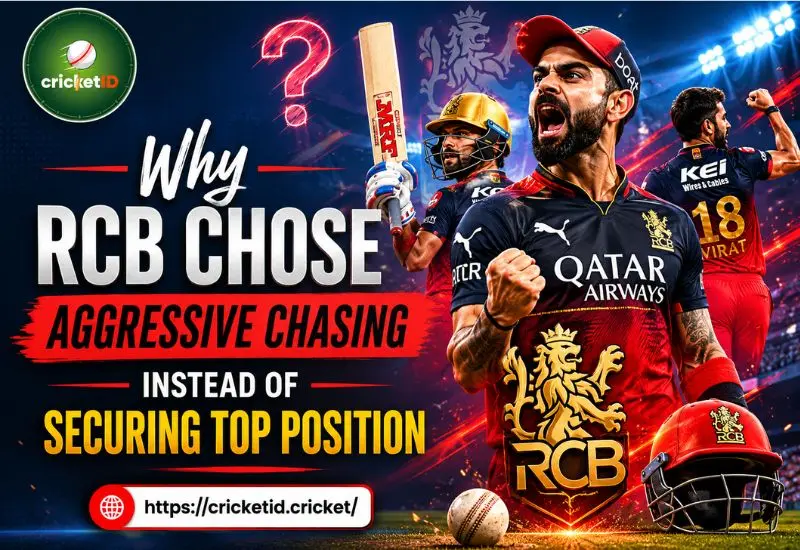
In the high-stakes world of the Indian Premier League (IPL), few tactical debates generate as much excitement — and controversy — as the choice between chasing big targets aggressively versus playing conservatively to protect a table position. In IPL 2026, Royal Challengers Bengaluru (RCB) made headlines not just for their stellar performances, but for a bold, deliberate philosophy: go all out when chasing, regardless of the optics of the points table.
With 18 points from 13 matches, an NRR of +1.065, and Virat Kohli leading the batting charts with 542 runs, RCB sat comfortably at the top of the IPL 2026 points table heading into their final league game. Yet even when facing Sunrisers Hyderabad in a match that could have been approached with caution, captain Rajat Patidar summed up the team’s mindset perfectly: ‘According to me, it doesn’t matter where you are on the points table.’ That single statement encapsulates everything about RCB’s remarkable run in IPL 2026.
This blog post breaks down exactly why RCB prioritised aggressive chasing as a core match strategy throughout the IPL 2026 season — and why it paid off so brilliantly.
Understanding the IPL Playoff Structure: Why NRR Matters
Before dissecting RCB’s approach, it’s important to understand the stakes involved. In the IPL 2026 playoff format, the top two teams in the league stage earn a crucial double chance — they play in Qualifier 1, and even if they lose, they get another shot via Qualifier 2. The third and fourth-placed teams go directly into the high-pressure Eliminator, where one defeat ends their season.
This structure makes Net Run Rate (NRR) a critical tiebreaker. If two teams are level on points, NRR decides who finishes higher. For RCB — a side that has historically flirted with heartbreak — building a healthy NRR was not just about vanity. It was an insurance policy. Every run scored quickly in a chase, every wicket preserved, directly contributed to a number that could separate them from rivals like Sunrisers Hyderabad (SRH) and Gujarat Titans (GT) on the table.
The Aggressive Chasing Blueprint: RCB’s Core Strategy in IPL 2026
RCB’s batting approach in IPL 2026 was built on a simple but powerful idea: when setting or chasing totals, do not slow down. The team consistently aimed for dominant victories rather than narrow wins. This was by design, not accident.
Here is what defined their aggressive chasing template:
- Explosive Powerplay Batting: Openers Virat Kohli and Phil Salt/Jacob Bethell were tasked with attacking from ball one, setting up frenzied starts that reduced the pressure on the middle order.
- No Gear Changes Mid-Chase: Unlike cautious sides that dial back aggression once a win looks likely, RCB maintained their tempo to maximise victory margins — critical for NRR arithmetic.
- Captain’s Selfless Approach: Rajat Patidar himself led from the front, playing attacking cricket even when a more measured approach might have been ‘safer’ for his personal numbers.
- Deep Batting Lineup: Players like Tim David, Venkatesh Iyer, and Krunal Pandya ensured that even if top-order wickets fell, the acceleration never stopped.
Virat Kohli: The Anchor Who Enables Aggression
Any discussion of RCB IPL 2026 is incomplete without talking about Virat Kohli. With 542 runs from 13 matches at an average of 54.20 and a strike rate of 164.74, Kohli delivered another vintage season. His numbers are not just impressive — they are strategically vital.
Kohli’s value in the context of aggressive chasing is multifaceted. When he fires, he provides a platform that allows others to take risks freely. When he plays a supporting role — as he occasionally did this season — his mere presence at the crease gives the batting unit structure, enabling power-hitters like Patidar and Tim David to go aerial without worrying about a collapse.
His experience of reading match situations — knowing when to press the accelerator versus when to rotate — makes him the ideal partner for the high-octane template RCB deployed in IPL 2026.
The NRR Game: How Aggressive Chasing Shaped RCB’s Table Position
Perhaps the clearest vindication of RCB’s aggressive approach in IPL 2026 is their NRR of +1.065 — one of the highest in the tournament. This number did not happen by accident. It was the cumulative result of consistently winning by large margins when chasing.
Consider the mathematics: if RCB had been content with ‘just winning’ — chasing down targets with 1 or 2 overs to spare rather than 4 or 5 — their NRR might have been +0.3 or +0.4. In a crowded playoff race where SRH (NRR: +0.350) and GT (NRR: +0.695) were breathing down their necks, that difference could have been the gap between finishing first and finishing third.
Their dominant six-wicket win over KKR is a prime example. By chasing the target down with authority and overs to spare, RCB moved ahead of GT on NRR, securing their grip on the top spot. That win was not just two points — it was a statement.
Rajat Patidar’s Philosophy: Why Position Doesn’t Define Ambition
Rajat Patidar‘s tenure as RCB captain in IPL 2026 has been characterised by bold decision-making and a refusal to play it safe. His pre-match remark ahead of the SRH clash — that table position doesn’t matter — was not bravado. It was a reflection of a deeply held team-first ethos.
Patidar understood that playing defensively to protect a top-two position would send the wrong message to his squad. Cricket, especially T20, rewards confidence. A team that starts thinking about what it has to lose, rather than what it can win, quickly loses its edge. By keeping the aggressive mandate alive even in the final league game, Patidar ensured his players went into the playoffs with the same fearless mindset that got them there.
Under his leadership, RCB have blended explosive batting with disciplined bowling — with Bhuvneshwar Kumar (leading wicket-taker in the tournament with 24 scalps) and Josh Hazlewood providing reliable cutting edges with the ball. The batting and bowling departments reinforce each other: bat aggressively, build NRR, and then let the bowlers defend challenging or par totals.
Risk vs. Reward: Is Aggressive Chasing Always the Right Call?
Naturally, critics have asked: isn’t aggressive chasing risky? What if RCB had collapsed chasing 256, like they faced in the SRH match? Could excessive aggression backfire?
These are fair questions. The counter-arguments are equally compelling:
- Batting depth negates collapse risk: With Tim David, Venkatesh Iyer, and Krunal Pandya in the lineup, RCB are rarely caught short of firepower down to No. 7 or No. 8.
- NRR benefits outweigh isolated losses: Even if an aggressive chase goes wrong once in a while, the cumulative NRR advantage gained over 13+ matches more than compensates.
- Playoff momentum: Teams entering the playoffs on a run of dominant wins carry momentum that conservative sides simply don’t. Confidence is contagious — and so is caution.
- T20 is inherently aggressive: In the modern game, sitting back invites pressure. Being proactive keeps the opposition under pressure instead.
The SRH match ultimately saw RCB lose by 55 runs — they were unable to chase down an imposing total — but crucially, they still held their top-two standing because of the NRR cushion they had built all season. Their aggressive chasing approach throughout the campaign was the very buffer that saved them when they fell short once.
What RCB’s Approach Tells Us About Modern T20 Strategy
The RCB IPL 2026 campaign offers a masterclass in modern T20 tournament strategy. Here are the key takeaways for cricket analysts, fans, and aspiring cricketers alike:
- NRR is a weapon, not just a statistic. Teams that build large NRRs give themselves a buffer for the final stages of the league table, turning what could be a tense final-day scramble into a formality.
- Consistency of approach breeds confidence. RCB never changed gears or second-guessed their identity mid-season. That consistency made them harder to plan against.
- Leadership mindset matters. Patidar’s refusal to prioritise table position over performance mindset shows how great captains shield their teams from external pressure.
- Bowlers enable batting aggression. Knowing their bowlers could defend 180+, RCB batters could swing freely. The dual strength created a virtuous cycle.
- Playoff seeding is earned, not managed. Trying to ‘manage’ a top position by playing safe is often counterproductive. The surest route to the top is to keep performing at full intensity.
Road Ahead: Can RCB Convert This into an IPL 2026 Title?
As IPL 2026 enters the playoff phase, RCB are well-placed. They head into Qualifier 1 in Dharamsala on May 26 against Gujarat Titans with momentum, a settled squad, and a clear tactical identity. Should they win, they advance directly to the final. Even a loss gives them another bite at the cherry in Qualifier 2.
The IPL 2026 title remains the ultimate prize for a franchise that has come agonisingly close on multiple occasions. But if this season has demonstrated anything, it is that this RCB side — led by a fearless captain, anchored by Virat Kohli‘s brilliance, and fired up by a bowling attack that leads the wickets chart — is built to win, not just to qualify.
Conclusion
RCB’s decision to prioritise aggressive chasing over cautious, position-securing cricket in IPL 2026 was not reckless — it was a finely calibrated strategy. It built an elite NRR, kept the team in peak competitive shape, and sent a clear message to every other team in the tournament: Royal Challengers Bengaluru do not play to survive. They play to dominate.
In a tournament where margins are razor-thin and one bad NRR number can end a season, RCB chose to stack the odds in their favour through performance. That philosophy — aggressive, consistent, and uncompromising — is precisely why they are heading into the IPL 2026 playoffs not just as participants, but as genuine title contenders.
Whether you are a die-hard RCB fan or a neutral observer, there is no denying the tactical intelligence behind their approach. In IPL 2026, RCB did not just chase targets. They chased greatness — and right now, greatness looks well within reach.