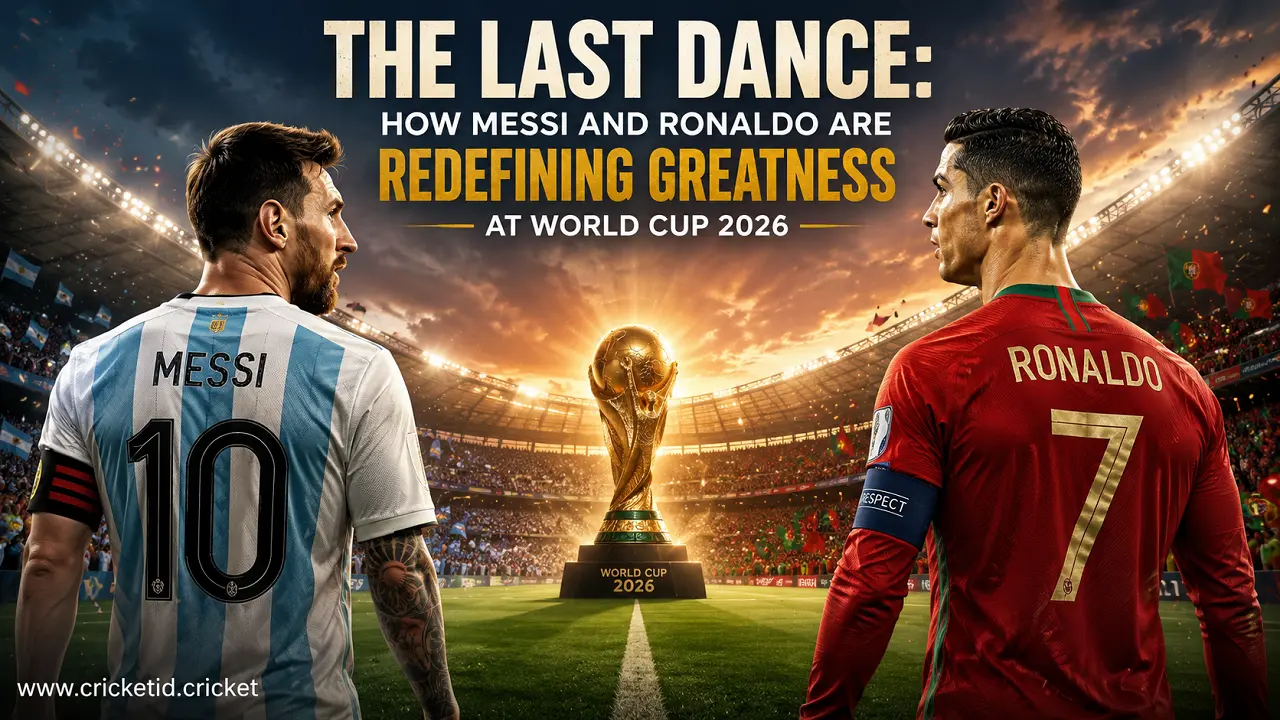
For nearly two decades, the football world has been locked in a binary debate: Lionel Messi or Cristiano Ronaldo? It has been a rivalry defined by Ballon d’Or counts, Champions League trophies, and domestic dominance. Yet, as the 2026 FIFA World Cup unfolds across North America, the narrative has shifted from competition to appreciation. We are witnessing the ultimate “Last Dance,” not just as a farewell tour, but as a masterclass in longevity that defies the very laws of athletic decline.
At 39 and 41, respectively, the two titans have arrived in the United States, Canada, and Mexico with one singular objective: to put a final, indelible stamp on the sport they transformed. While the tournament’s expanded 48-team format has introduced a wave of fresh, hungry talent, it is the familiar faces of Messi and Ronaldo that continue to draw the largest crowds, capture the most headlines, and dominate the digital landscape.
Their reach is so profound that even in Cricket ID obsessed nations where football is often a secondary passion, the mere mention of their names commands the same reverence usually reserved for iconic sporting idols, proving that true greatness transcends the boundaries of the football pitch and the stadium alike.
A Historic Milestone: Messi’s Goal-Scoring Supremacy
Lionel Messi’s legacy has long been secure, but his performance in the 2026 group stages has added a layer of historical significance that even his greatest detractors cannot ignore. Entering this tournament, the record for the most goals in men’s World Cup history stood at 16, held by German legend Miroslav Klose.
With his clinical brace against Austria and a stunning, trademark free-kick against Jordan, Messi didn’t just break the record—he shattered it. Sitting at 19 goals in 29 appearances, the Argentine captain has officially moved into a stratosphere of his own.
Beyond the raw numbers, it is the manner of his contribution that remains startling. In an era where pressing and physical intensity define the modern game, Messi has adapted his style to perfection. He acts as the conductor of the Argentine symphony, choosing his moments to accelerate, his passing lanes to exploit, and his spaces to inhabit with an intelligence that only comes from decades at the summit. He has now become the first player in history to score in seven consecutive World Cup matches, a statistic that underscores a level of consistency rarely seen in any professional sport.
The Human Element: When Even Legends Miss
However, the 2026 campaign has also served as a reminder of the fragility of even the greatest icons. In a moment that stunned the crowd in Dallas, Messi missed a crucial spot-kick during the group stage. This brought his total number of missed World Cup penalties to three, moving him past Ghana’s Asamoah Gyan for the most misses in the tournament’s storied history.
Why does this matter? Because it humanizes the myth. For a generation of fans who have grown up watching Messi pull off the impossible, seeing him fail in such a public, high-pressure moment serves as a poignant reminder that he is, after all, mortal. It adds a layer of vulnerability to his journey, making the inevitable triumphs that follow feel all the more earned. It is a testament to his mental fortitude that, despite the miss, he returned to the same match to dictate the tempo and secure a victory for his nation.
The Six-Peat: Ronaldo’s Unrelenting Drive
If Messi is the surgeon, Cristiano Ronaldo is the gladiator. At 41, the Portuguese icon has achieved something that, until now, seemed medically impossible for a forward: he has become the first male player to score in six different World Cup editions.
Ronaldo’s 2026 journey is a case study in physical maintenance and psychological resilience. While he may no longer possess the blistering pace that defined his Manchester United or Real Madrid years, his positioning remains world-class. He plays with the awareness of a veteran who knows exactly where the ball will land before it even leaves the midfielder’s foot.
During Portugal’s grueling group stage matches, including a physical 0–0 stalemate with Colombia, Ronaldo’s influence was felt in ways that go beyond the scoresheet. His mere presence forces opposing defenses to collapse inward, double-teaming him and leaving vast swaths of open space for Portugal’s emerging talents. He has embraced a new role—a target man and a mentor—while still harboring the hunger of a teenager. Watching Ronaldo sprint into the box in the 90th minute of a deadlocked match is a reminder of a career built on the foundation of sheer, unrelenting discipline.
The Tactical Shift: Veterans in a New World
The 2026 World Cup’s expanded format has provided a unique stage for these two legends to operate. The increased number of teams has diluted the talent pool slightly, which has, in some ways, played into the hands of the veterans. Messi and Ronaldo are now facing nations that are not always accustomed to the tactical speed and technical precision required to stifle players of their caliber.
However, this also means they are carrying the weight of their entire nations more heavily than ever. For Argentina, the reliance on Messi remains absolute; he is the spark that ignites their transitions. For Portugal, Ronaldo acts as the emotional and tactical anchor. The pressure is immense, yet both players seem to be thriving in the spotlight, knowing full well that this is their final attempt to lift the most prestigious trophy in sports once more.
A Shared Legacy: From Rivalry to Mutual Respect
For years, the media and fans fueled the “Messi vs. Ronaldo” fire, creating a toxic environment where one player’s success was interpreted as the other’s failure. But as the knockout rounds of 2026 begin, that dynamic has vanished.
There is a palpable sense of mutual respect between the two. They have lived parallel lives, pushing each other to achieve things that would have been impossible in isolation. Now, as they approach the twilight of their careers, there is a collective understanding among fans: we are witnessing the closing chapters of a story that will be told for centuries.
Looking Toward the Final
As the tournament moves toward the Round of 32 and beyond, all eyes will remain on the two icons. Argentina heads into the knockouts with the momentum of a perfect group stage, while Portugal faces a challenging path that will test their endurance and tactical flexibility.
Whether they lift the trophy or fall short, the 2026 World Cup has already served its purpose in their narratives. It has proven that greatness is not merely about the peak—it is about how long you can sustain the climb. Messi and Ronaldo have climbed higher and longer than anyone else.
We are not just watching a football tournament anymore; we are watching the final acts of two of the greatest athletes to ever grace the earth. Win or lose, their performance in North America ensures that when the “Last Dance” music eventually fades, the applause will be deafening and universal. The GOAT debate may never truly end, but one thing is certain: we are incredibly lucky to have been here to see it.
How would you like to refine this, or should we move on to drafting a specific social media strategy to promote this article?